Showing posts with label Health and Fitness. Show all posts

Monday, March 25, 2013

Honey & Cinnamon

I found this on a facebook post. Although I don't think it is quite the "cure all" it says it is, I do think there is something to this and wanted to save it for reference.


Facts on Honey and Cinnamon:
It is found that a mix of honey and Cinnamon cures most diseases. Honey is produced in most of the countries of the world. Scientists of today also note honey as very effective medicine for all kinds of diseases. Honey can be used without side effects which is also a plus.Today's science says that even though honey is sweet, when it is taken in the right dosage as a medicine, it does not harm even diabetic patients. Researched by western scientists:

HEART DISEASES: Make a paste of honey and cinnamon powder, put it on toast instead of jelly and jam and eat it regularly for breakfast. It reduces the cholesterol and could potentially save one from heart attack. Also, even if you have already had an attack studies show you could be kept miles away from the next attack. Regular use of cinnamon honey strengthens the heart beat. In America and Canada, various nursing homes have treated patients successfully and have found that as one ages the arteries and veins lose their flexibility and get clogged; honey and cinnamon revitalize the arteries and the veins.

ARTHRITIS: Arthritis patients can benefit by taking one cup of hot water with two tablespoons of honey and one small teaspoon of cinnamon powder. When taken daily even chronic arthritis can be cured. In a recent research conducted at the Copenhagen University, it was found that when the doctors treated their patients with a mixture of one tablespoon Honey and half teaspoon Cinnamon powder before breakfast, they found that within a week (out of the 200 people so treated) practically 73 patients were totally relieved of pain -- and within a month, most all the patients who could not walk or move around because of arthritis now started walking without pain.

BLADDER INFECTIONS: Take two tablespoons of cinnamon powder and one teaspoon of honey in a glass of lukewarm water and drink it. It destroys the germs in the bladder....who knew?

CHOLESTEROL: Two tablespoons of honey and three teaspoons of Cinnamon Powder mixed in 16 ounces of tea water given to a cholesterol patient was found to reduce the level of cholesterol in the blood by 10 percent within two hours. As mentioned for arthritic patients, when taken three times a day, any chronic cholesterol-could be cured. According to information received in the said Journal, pure honey taken with food daily relieves complaints of cholesterol.

COLDS: Those suffering from common or severe colds should take one tablespoon lukewarm honey with 1/4 spoon cinnamon powder daily for three days. This process will cure most chronic cough, cold, and, clear the sinuses, and it's delicious too!

UPSET STOMACH: Honey taken with cinnamon powder cures stomach ache and also is said to clear stomach ulcers from its root.

GAS: According to the studies done in India and Japan, it is revealed that when Honey is taken with cinnamon powder the stomach is relieved of gas.

IMMUNE SYSTEM: Daily use of honey and cinnamon powder strengthens the immune system and protects the body from bacterial and viral attacks. Scientists have found that honey has various vitamins and iron in large amounts. Constant use of Honey strengthens the white blood corpuscles (where DNA is contained) to fight bacterial and viral diseases.

INDIGESTION: Cinnamon powder sprinkled on two tablespoons of honey taken before food is eaten relieves acidity and digests the heaviest of meals

INFLUENZA: A scientist in Spain has proved that honey contains a natural 'Ingredient' which kills the influenza germs and saves the patient from flu.

LONGEVITY: Tea made with honey and cinnamon powder, when taken regularly, arrests the ravages of old age. Use four teaspoons of honey, one teaspoon of cinnamon powder, and three cups of boiling water to make a tea. Drink 1/4 cup, three to four times a day. It keeps the skin fresh and soft and arrests old age. Life spans increase and even a 100 year old will start performing the chores of a 20-year-old.

RASPY OR SORE THROAT: When throat has a tickle or is raspy, take one tablespoon of honey and sip until gone. Repeat every three hours until throat is without symptoms.

PIMPLES: Three tablespoons of honey and one teaspoon of cinnamon powder paste. Apply this paste on the pimples before sleeping and wash it off the next morning with warm water. When done daily for two weeks, it removes all pimples from the root.

SKIN INFECTIONS:Applying honey and cinnamon powder in equal parts on the affected parts cures eczema, ringworm and all types of skin Infections.

WEIGHT LOSS:Daily in the morning one half hour before breakfast and on an empty stomach, and at night before sleeping, drink honey and cinnamon powder boiled in one cup of water. When taken regularly, it reduces the weight of even the most obese person. Also, drinking this mixture regularly does not allow the fat to accumulate in the body even though the person may eat a high calorie diet.

CANCER: Recent research in Japan and Australia has revealed that advanced cancer of the stomach and bones have been cured successfully. Patients suffering from these kinds of cancer should daily take one tablespoon of honey with one teaspoon of cinnamon powder three times a day for one month.

FATIGUE: Recent studies have shown that the sugar content of honey is more helpful rather than being detrimental to the strength of the body. Senior citizens who take honey and cinnamon powder in equal parts are more alert and flexible. Dr. Milton, who has done research, says that a half tablespoon of honey taken in a glass of water and sprinkled with cinnamon powder, even when the vitality of the body starts to decrease, when taken daily after brushing and in the afternoon at about 3:00 P.M., the vitality of the body increases within a week.

BAD BREATH: People of South America, gargle with one teaspoon of honey and cinnamon powder mixed in hot water first thing in the morning so their breath stays fresh throughout the day.

HEARING LOSS: Daily morning
and night honey and cinnamon powder, taken in equal parts restores hearing.

Sunday, July 24, 2011

Kefir Grains: How To's and Health Benefits.

I've been using real kefir grains for several months now to make kefir and have found the health benefits and nutritional value to be amazing.  I got mine from friends, and have sent some out to others since (you can't buy the real thing in the store).  Unfortunately they don't come with written instructions when a friend sends some to you and because I've been giving grains to more people lately, I thought I'd put a post together on what to do.

If your interested in knowing more about kefir and their health benefits I'll leave that up to the experts...
  • Patty Donovan wrote "Grow Your Own Probiotics, Part 1: Kefir" back in 2008.  Awesome article.
  • Dominic Anfiteatro has a webpage with an overload of info.  I love that he lists different probiotic strains, yeast strains, recipes, and much more. 
  • One more website has awesome recipes and further info on how to's.
So with all that out of the way, this is how it goes down...

Kefir
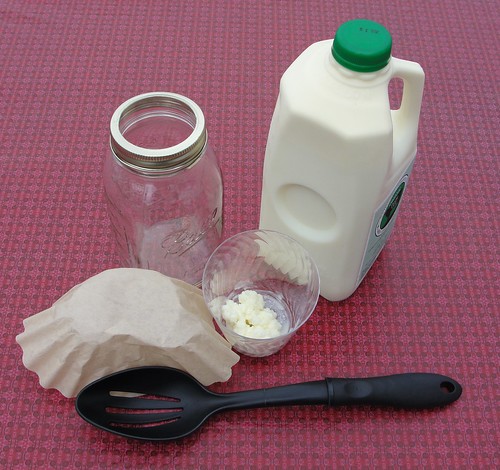
This is everything you'll need for making kefir.  Mason jars and some type of cloth or napkin (I use coffee filters) are perfect but you can use any glass or plastic container.  Some folks say there is a risk in killing the kefir grains if you use metal so I stick with glass and plastic when messing with this stuff to be safe.

SOURCE: You can either get grains from a friend who has some, or you can order them online.  You can't buy the real thing in the store though.  You CAN get a starter pack in the store, but they will die after a handful of uses and from what I understand don't have all the nutritional benefits and vitamins that the real grains have.  So however you get your Real grains, they will either come ready to go or dehydrated.

MILK VARIETIES:
  • You can use any kind of milk, but if you want your grains to continue to live and produce kefir you have to use milk from a mammal of some kind.  Cows, goats....  Whole milk is best, raw milk is even better.  I've even used the pasteurized, homogenized milk before but the health benefits go much further with better quality milk. 
  • You can even culture other types of milk such as soy or coconut milk, but use spare grains for milk that doesn't come from a mammal because the grains will eventually die off in that kind of milk. 


(And by spare grains I should add here that the grains tend to double in size about once a week.) 

ENVIRONMENTAL TEMPERATURES make a difference in the speed at which they reproduce.  The warmer side of room temperature will speed up growth of grains and kefir liquid production, the cooler side of room temperature will slow them down.  You can send the extra grains to friends, or double the health benefits by adding them to your smoothies.


Kefir Grains
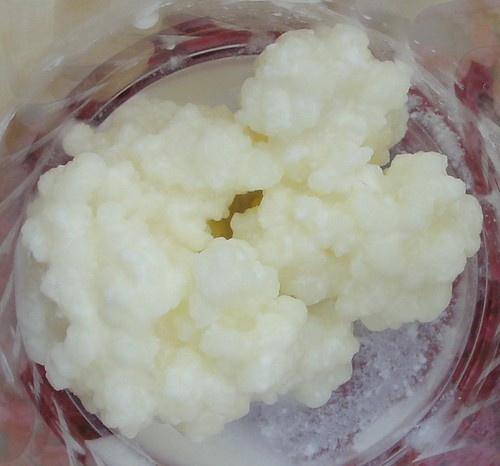
This is what real Hydrated kefir grains look like.  If yours are Dehydrated you'll want to continue milk changes daily until they start working.  It may take a few days to a week to bounce back after shipping to where it's producing liquid kefir like it should.

Kefir
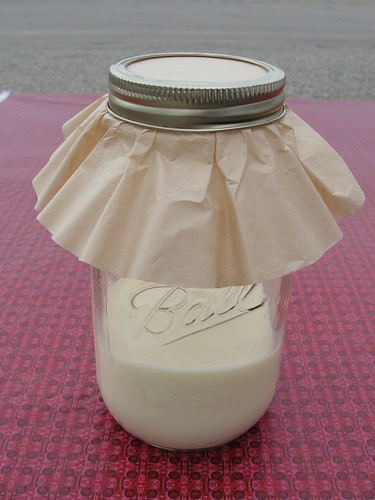
So the first thing you do with your kefir grains is put them into a jar of milk.  You'll want to give 1 to 1 & 1/2 cups of milk per tablespoon of kefir grains (I never do exact measurements).  You don't want to seal the jar because the yeast fermentation will build up pressure, which is why I use the coffee filter to cover the top of the mason jar.  The filter (or napkin) allows it to breath and yet keeps things from falling into the jar.  Use milk straight from the fridge (no need to let it warm) and store jar out of direct sunlight for 12 - 24 hours, stirring a few times a day.

Kefir
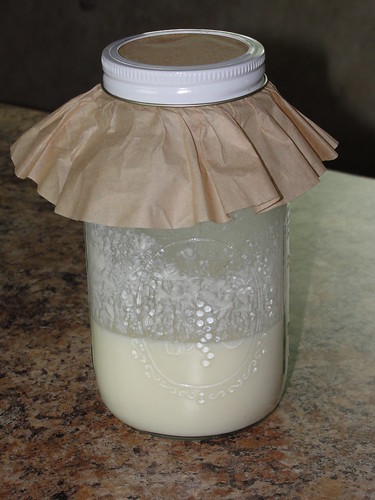
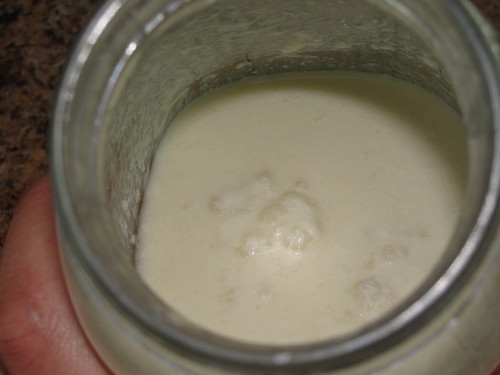
This is what it should look like after 24 hours - I just stirred it.  See how it looks above the milk line?  That's how it's suppose to look, kinda particlely and grainy.  If it isn't stirred it will build up pockets of clear liquid called kefir whey, the white will become extremely thick.  It's best to stir it so the grains don't suffocate in the thick stuff.  By stirring it, you are helping more lactose to get to the grains, which is what the grains eat and need to survive.


Kefir
This is another angle of stirred, 24 hour kefir.  The big chunks you see are the grains, as they like to float when their at their best.  The liquid kefir should look grainy or with tiny chunks after stirring it although it's hard to see here, it will also be rather like the consistency of a melted milkshake - thicker liquid than just milk.  If you leave a glass of milk out on the counter for 24 hours it does not look thick and particley like the liquid kefir does, it stays like milk and only shows a milk ring around the glass at the top of the milk line.  If your kefir stays like milk after leaving it out, better skip ingesting it until the kefir grains are turning out liquid kefir as they should.  It's pretty hard to kill your kefir grains so if they aren't working as they should, just keep changing their milk daily and they will bounce back pretty quickly.

If you are using to much milk your liquid kefir won't turn out thick or as grainy (which is ok if you want thinner consistency).

One last bit of helpful information is how to store your grains when you need a break from producing kefir, or when your going on vacation. 

I plan on adding a few more posts with recipes, ways to boost the vitamins and probiotics and hopefully stories of how this stuff can help in specific ways.  Just look for posts tagged "Kefir" which you can find by looking in the right hand column under the "Tags" heading.

Saturday, June 25, 2011

Nettles pack power as ‘people’s medicine’

Published Tuesday, June 25th 2011

Nettles pack power as ‘people’s medicine’

• Alaska’s wild plant expert Janice Schofield pays Homer a visit, plans a new herbal medicine book based on native flora
By Naomi Klouda
Homer Tribune


Janice Schofield
Janice Schofield
The backyard, full of dandelions, horsetails, devil’s club and nettles may seem more problem than gift. But each of those plants has a use that is power-packed for health.

Consider that in Japan, devil’s club was literally loved to death. Today, the plant needs to be imported because widespread use as a healing herb has nearly wiped them out, said Janice Schofield, a foremost authority on Alaska’s wild plants who made a visit to Homer to host an edible plant workshop last week.
Nettles are shy plants often found behind or shaded by large wild shrubs. Hikers know the sting and the burning itch of bare-skin contact. Horsetails, that ancient plant that shows up in fossil records from the dinosaur era, can be used to immediately counteract the sting by scrubbing it across the irritated area.

Nettles offer a powerhouse for remedies to keep a prostate healthy, cure a urinary track infection and inhibit bleeding, said Schofield, author of “Discovering Wild Plants” and “Alaska’s Wild Plants.” Her first acquaintance with the weeds began here in Kachemak Bay in the early 1980s. She spent a year studying nettles. “I realized I was only at the tip of the iceberg – there is such a long relationship between humans and nettles.”

In her fascination, Schofield wrote an entire book, “Nettles,” in the Keats Good Herb Guide series, that currently is out of print and in want of a new publisher.

The book goes into great detailed explanation of the plant’s chemical properties and how they function. Teens may want to try a nettle concoction to help alleviate acne. The fresh-pressed juice of nettle plants is laden with chlorophyll and other nutrients. In France, nettles are used as medical treatment for mild to moderate acne. Here’s an explanation she presents from an herbalist: “Since the blood must maintain its slightly alkaline pH and since nearly all the waste products the body produces are acid, something like nettle tea helps to add electrolytes and alkali to assist the buffering system when under stress, and nettle specifically helps increase the transport and excretion of blood nitrogen waste products.”

For this reason, a cup of nettle tea one to three times a day can help relieve acne and other painful skin conditions like eczema and psoriasis. Even arthritis can be relieved by ingesting nettles as a tonic. The juice can be preserved by adding 10 percent grain alcohol or 25 percent brandy. Or, Schofield recommends, freeze the fresh juice in ice cube trays and thaw one as needed.

When hiking in summer, any number of mishaps can occur in the outdoors. It might come in handy to know that nettles can inhibit bleeding because it is an astringent and tightens tissues. Nettle powder can be sprinkled on cuts to aid in coagulation.

Schofield also found research that credits a mixture of burdock and nettles (half and half) taken as a tea eases premenstrual syndrome. Nettle root has been used to treat enlarged or irritated prostates. Drinking nettle tea during pregnancy (be sure to get nettles in the early spring only) aids health and afterward, helps nursing mothers produce milk. Nettle seeds, which contain oils and traces of formic acid, can be used as a scalp conditioner and hair-growth stimulant for people who have undergone chemotherapy. Take a teaspoon of seeds, soak in a cup of hot water for twenty minutes and use as a rinse after shampooing, recommends herbalist Michael Moore in Schofield’s research.

Young plants are best
The only case of a person dying or becoming ill from nettle use that Schofield knows of occurred in Australia where a species of nettles is a dangerous rainforest dweller. Contact with the razor sharp hairs burn for weeks and months even. But the Alaska variety is safe if taken in its prime. Later in the season, when the plant’s leaves are larger than two-inches in diameter and it starts flowering, it becomes unhealthy.

“If you are observing the plant, it will tell you if it’s the right time to use it,” Schofield said. “When it’s young, it’s vibrant and juicy. As it’s older, it becomes courser and dry, constricting fluids and juices.”

Nettles are best used in the spring, when the plant is 10-12 inches high. But if you have a grove of nettles in the yard that you have used as the season progresses, they tend to replenish themselves and can be harvested all summer. Look for the small new growths in a nettle grove that may be hidden by the more mature stalks. Plants in use tend to oblige humans by growing back more plentifully. “After they flower, the plant becomes more irritating to the urinary track. Once bugs get into the nettles, the harvest is over,” she advises.

How Scholfield began
Schofield came to know Alaska’s herbs and write numerous articles and books on the subject because there was so little out there. In 1980, she and her husband moved to the head of Kachemak Bay and later they lived by Red Mountain. She had earned her degree in home economics and felt a keen curiosity about the nettle groves around her, as well as other plants she found fascinating like wild roses, dandelions and devils club. What could they be used for? Few books were available to help answer her extensive curiosity, so she decided to write one. Her quest took her all over the state, seeking out traditional Alaska Native uses and researching herbalists’ works and scientific findings from around the globe. Thirty years and thousands of pages later, Schofield is highly sought out as probably Alaska’s foremost expert on wild plants. Her workshop, co-hosted with Nancy Lee Evans, was attended by 24 people.

“What you see now is the byproduct of trial and error, flops and successful attempts,” Schofield said in an interview with the Homer Tribune. Now she lives in New Zealand, and is writing another book, “Health Plants of Alaska.” Sadly, much of the manuscript burned in a fire that destroyed her home earlier this year.
Her trip to Homer was the first trip back to her beloved Kachemak Bay in four years.

Weeds and wild plants tend to be taken for granted- or attacked with strong killing sprays – but Alaskans probably shouldn’t do that, she said. “The pureness and availability makes Alaska plants very healthy. Other places don’t always have these plants. Dandelions, for example – they don’t grow in the wild in New Zealand.”

Devil’s club was wiped out in Japan because the stems and roots are found to be beneficial as a medicine to regulate sugar levels, as in diabetes, and also to regulate blood pressure.

“This is the people’s medicine, these weeds. It’s to use for health, not just as a medicine which is what you need when you are sick. It keeps you in balance, strengthens immunity – its how to keep your family, kids and animals healthy.”

To start with, Schofield recommends getting to know 10 plants around your yard. Many in Homer contain dandelions, devils club, cow parsley (puski), nettles, horsetail, wild roses, raspberry plants and fireweed. All of these have specific uses.

“They form a community of plants, an ecosystem, and a good reason to not eradicate them through weed killers is because once one is gone, the community health of plants suffer,” she said. “They keep the landscape healthy.”

HOMER TRIBUNE/Naomi Klouda - An abundance of local recipes for nettle use are shared in Homer. Lasse Holmes creates a Nettle Creme Tonic beer; Two Sister’s Bakery Owner Carrie Thurman makes a nesto pesto. Public Health Nurse Bonnie Betley makes pasta of nettles and the Kilcher family is credited with many other suggested uses. Schofield lists many in her books as well.
A commenter to the article also left this added bit of helpful information:
As a big herbal medicine aficionado, I try to make all my own herbal tinctures as well. My favorite reference is Charles Kane’s Herbal Medicine-Trends and Traditions…a fantastic herbal resource book. It’s the only herbal I’ve seen to have tincture-making worksheets, and the proper alc/water percentages and dosages for 400+ herbs…highly recommended as a medicine-makers manual.